Every enterprise today is investing in AI. Budgets are allocated. Leadership is aligned. LLM vendors have been evaluated. And yet, in boardroom after boardroom, the same conversation happens: "Our models are only as good as our data, and our data isn't ready." This is the central challenge of enterprise AI, and it is fundamentally a data engineering problem.
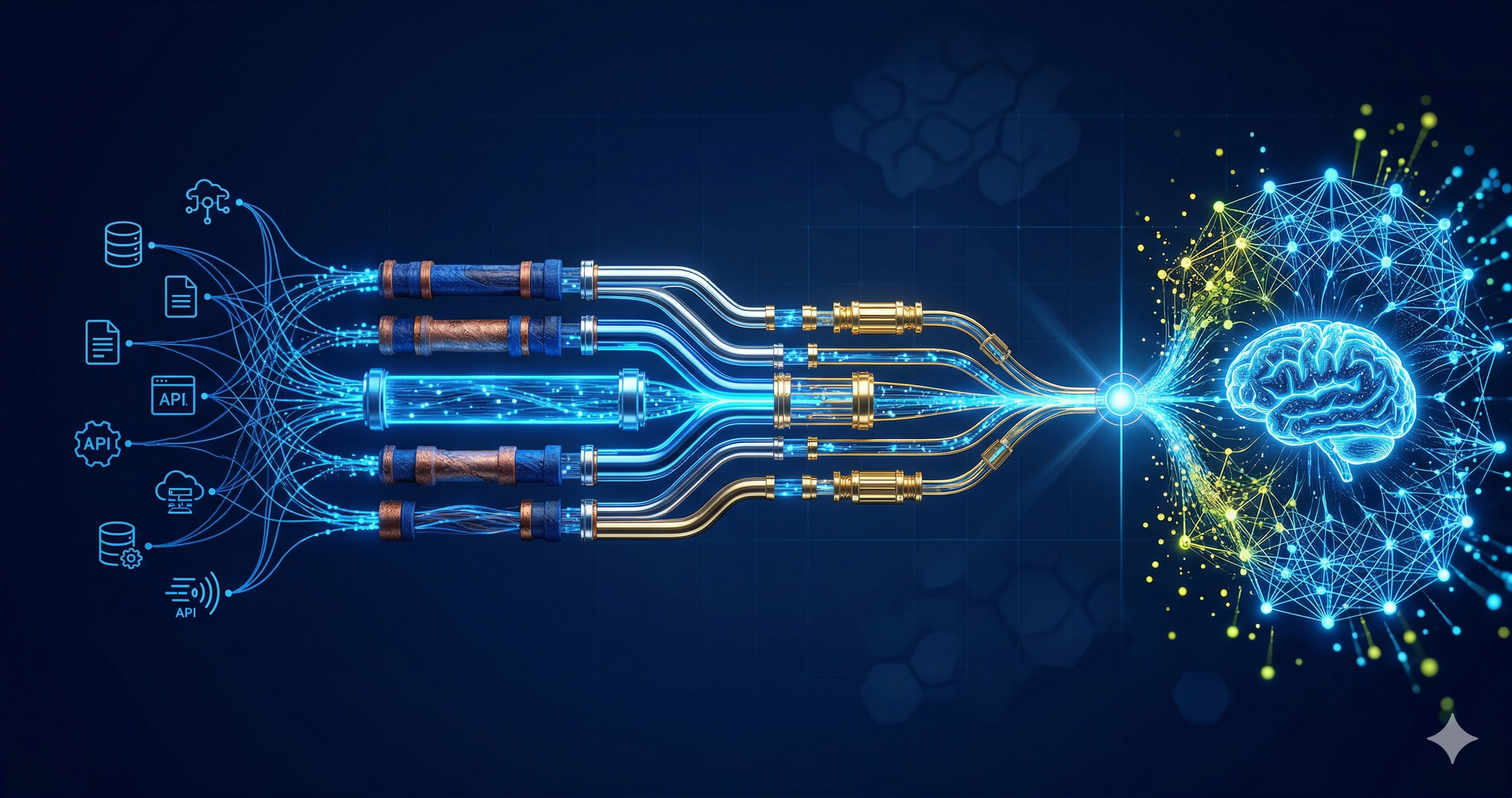
The Hidden Bottleneck in Enterprise AI
When organizations hit a wall with their AI initiatives, the failure point is rarely the model. It is almost always the data layer underneath it. Data trapped in silos, pipelines that nobody fully understands, no lineage, no observability, governance that exists only on paper. The models are ready. The data platform is not.
This is not a new problem, but AI has made it impossible to defer. The organizations pulling ahead on AI are not necessarily the ones with the best models. They are the ones with the most disciplined, well-engineered data platforms beneath those models. Curated, governed, trustworthy data, delivered at speed, is the actual competitive advantage.
Industry Reality: Gartner estimates that over 80% of AI project failures are attributable to poor data quality, missing pipelines, or inadequate data infrastructure — not the AI models themselves. Building on an unstable data foundation does not produce AI that works in production. It produces expensive prototypes.
What Modern Data Engineering Actually Looks Like
The term "modern data stack" gets used loosely. In practice, it describes a specific architectural philosophy: treat data infrastructure with the same engineering discipline applied to production software. That means version control, CI/CD, automated testing, observability, and governance built in — not bolted on.
The technologies that define this space today are well-established, but the discipline to operationalize them at enterprise scale is less common.
Lakehouse Architecture: The Foundation
The Lakehouse pattern — combining the scale and openness of a data lake with the performance and governance of a data warehouse — has become the dominant architectural pattern for enterprise data platforms. Implementations built on Snowflake, Databricks, and Delta Lake with open table formats like Apache Iceberg provide the flexibility enterprises need without sacrificing the reliability that production workloads demand.
The medallion architecture (Bronze, Silver, Gold layers) sits at the heart of most modern Lakehouse implementations. Raw data lands in Bronze, gets cleaned and validated in Silver, and becomes business-ready in Gold. Simple in concept, but the engineering required to make this reliable, observable, and AI-ready at scale is significant.
Core technologies: Apache Iceberg · Delta Lake · Snowflake · Databricks · Medallion Architecture · Data Vault 2.0 · Semantic Layer · Unity Catalog
DataOps and GitOps for Data: Engineering Discipline at the Pipeline Layer
The biggest shift in mature data organizations is treating data pipelines the way software engineers treat application code. Every transformation, every DAG, every schema change goes through version control, code review, automated testing, and environment-gated promotion before it touches production.
This is DataOps in practice. Not a methodology document, but a real operating model. GitOps-driven CI/CD using GitHub Actions, GitLab CI, or Azure DevOps, with dbt Core or dbt Cloud handling modular, tested, documented SQL transformations. Blue/green pipeline deployments with zero-downtime rollouts. Automated dbt schema tests and data contract validation that catch quality regressions before they reach stakeholders.
The result is that data engineers ship faster, with far fewer production incidents, and with full audit trails that compliance and governance teams can actually use.
"The data teams that move fastest are not the ones with the most engineers. They are the ones with the most disciplined deployment pipelines. GitOps for data is not optional anymore."
Apache Airflow: The Orchestration Backbone
Apache Airflow remains the de facto standard for workflow orchestration in serious data engineering environments, and for good reason. DAG-based scheduling, data-aware scheduling, a rich operator ecosystem, and a REST API that enables event-driven triggers from upstream systems make it genuinely enterprise-grade. Deployed on Kubernetes (AKS, EKS) with Astronomer Cosmos for native dbt integration, Airflow handles orchestration for workflows ranging from straightforward ETL pipelines to complex multi-system ML workflows.
For AI workloads specifically, Airflow's ability to orchestrate feature engineering pipelines, model training jobs, and inference workflows within the same DAG framework that manages production data pipelines is a meaningful operational advantage.
Core technologies: Apache Airflow · Astronomer Cosmos · DAG Factory · Data-Aware Scheduling · Kubernetes (AKS/EKS) · REST API Triggers
Real-Time Streaming and Change Data Capture
Batch pipelines are necessary, but they are not sufficient for AI applications that need current context. Real-time streaming with Apache Kafka, Debezium CDC, and Azure Event Hubs enables the kind of low-latency data delivery that modern AI-powered applications actually require.
Change Data Capture from operational databases (MSSQL, PostgreSQL, Oracle) into Snowflake Streams and Tasks eliminates the batch processing lag that has historically made operational data unsuitable for real-time AI inference. The move from hours-of-latency batch jobs to minutes-of-latency streaming pipelines is often the single most impactful infrastructure change an enterprise can make for its AI programs.
Core technologies: Apache Kafka · Debezium CDC · Azure Event Hubs · Kafka Connect · Snowflake Streams & Tasks · KSQL · Real-Time Ingestion
Data Quality, Observability, and Lineage: The Governance Layer
Untrustworthy data is worse than no data. It produces models that give confident wrong answers. Data quality must be code, not conversation. Great Expectations, dbt tests, and schema contracts enforced in the CI/CD pipeline catch quality regressions before they propagate downstream.
Full pipeline observability via OpenLineage, Marquez, and OpenTelemetry into Prometheus with Grafana dashboards gives operations teams real-time visibility into pipeline health. When something breaks, the alert surfaces immediately and the lineage trace shows exactly what downstream datasets are affected. For enterprises with AI workloads, this transparency is not optional. It is the difference between governed AI and ungoverned automation.
Core technologies: Great Expectations · OpenLineage · OpenTelemetry · Prometheus · Grafana · dbt Tests · Data Contracts · Schema Registry
The AI-Ready Data Platform: What It Actually Requires
Building for AI is not just about having clean data. It requires a specific set of capabilities that most legacy data platforms were never designed to support.
Vector Embeddings and RAG Pipelines LLM-powered data products depend on retrieval-augmented generation. The data platform must support vector embedding pipelines that convert enterprise knowledge into searchable, contextual representations. This is infrastructure work, not data science work.
Feature Engineering Pipelines ML models require curated, versioned, continuously refreshed feature sets. Snowpark, Databricks Feature Store, and Azure ML integration, orchestrated via Airflow, ensures features are production-grade and reproducible.
MLflow and Experiment Tracking Model training, validation, and inference pipelines need the same observability as data pipelines. MLflow integration within Airflow-orchestrated workflows provides full experiment lineage and model governance alongside data lineage.
Compliance by Design Column-level security, row-level filtering, RBAC, and OKTA SSO built into the data platform architecture. AI governance is only credible when the underlying data access controls are demonstrably correct and auditable.
Data Mesh: Scaling Governance Without Slowing Teams
Central data platforms become bottlenecks as organizations scale. Data mesh addresses this by shifting ownership of data products to the domain teams that understand them best, while maintaining platform-level guardrails through shared infrastructure, standards, and governance.
In practice, this means implementing data contracts between producers and consumers, automated schema compatibility checks, and self-serve data product publishing with Unity Catalog (Databricks) or Snowflake RBAC enforcing fine-grained access at scale. Domain teams move fast. Central governance still holds. This is the architecture that makes enterprise AI at scale operationally sustainable.
How DataZ Solves This at Enterprise Scale
DataZ is CloudControl's data engineering and DataOps service practice, built specifically to help enterprises close the gap between where their data platform is and where it needs to be to support production AI. It brings software engineering discipline to data, combining GitOps CI/CD, Apache Airflow orchestration, dbt transformations, real-time streaming, and full-stack observability into a unified operating model.
The practice covers the full modern data stack, from Lakehouse architecture design through to AI-ready pipeline engineering, with delivery experience across Snowflake, Databricks, Azure Data Factory, and multi-cloud environments.
| Metric | Result |
|---|---|
| Live Data Pipelines | 90+ |
| Data Under Management | 360TB+ |
| Manual Deployments | Zero |
| Environments | Multi-Cloud + On-Prem |
DataZ is not a consulting engagement that hands over a design document. It is a delivery-oriented practice that takes enterprises from their current state to production-grade DataOps, with outcomes that are measurable, auditable, and built to scale.
What DataZ Delivers
Lakehouse and Modern Data Stack Architecture on Snowflake, Databricks, and Delta Lake with Apache Iceberg open table formats and full medallion architecture implementation. GitOps CI/CD for data with feature branch workflows, automated dbt testing, and environment-gated promotions across DEV, QA, and PROD. Real-time streaming pipelines with Apache Kafka, Debezium CDC, and Snowflake Streams reducing data latency from hours to minutes. Full-stack observability with OpenLineage, Prometheus, and Grafana giving operations real-time visibility into every pipeline. Data mesh enablement with data contracts, schema registries, and domain-level data product ownership at scale.
A Real-World Example: Global Financial Services
A global financial services firm was operating critical data workflows on ad-hoc scripts with no version control, no pipeline observability, and error-prone manual deployments. Data engineering teams were firefighting daily rather than building. Their Snowflake environment had no governance, no lineage, and costs were growing without any visibility into why.
CloudControl deployed DataZ, establishing a full GitOps CI/CD pipeline for Apache Airflow and dbt Core with Astronomer Cosmos. Over 200+ production tasks spanning ESG, enterprise data, and trade allocation domains were onboarded within weeks. Snowflake Streams and Tasks replaced batch jobs, cutting data latency from hours to minutes. A full observability stack with OpenTelemetry, Prometheus, and Grafana gave operations real-time pipeline visibility for the first time. Blue/green deployments eliminated downtime during model updates. Azure Key Vault-backed secret management and RBAC ensured every environment was secure and audit-ready from day one.
| Outcome | Result |
|---|---|
| Tasks Automated | 200+ |
| Manual Deployments | Zero |
| Data Latency | Minutes (vs. Hours) |
| Systems Integrated | 6+ |
| PoC to Production | Weeks |
Where to Start
For most enterprises, the right starting point is a DataOps maturity assessment. Not a lengthy consulting engagement, but a focused, technical review of where the current data platform sits against the benchmarks of modern data engineering — specifically in the context of what it will need to support production AI workloads.
The gaps are almost always the same: no CI/CD for data pipelines, limited or no observability, ad-hoc orchestration with no audit trail, and data quality that relies on heroic effort from individual engineers rather than systematic controls. These are solvable problems. They are not novel problems. What they require is structured execution, the right tooling, and an engineering team that has done it before.
If your AI roadmap is stalling because the data isn't ready, the answer is not more data scientists. The answer is better data engineering.
Start with a DataOps Maturity Assessment. Talk to the DataZ team about a focused review and a pilot on your stack. No long engagements, no fluff, just honest engineering. Reach out at mrsiddiqui@ecloudcontrol.com.