This is Article 02 of 03 in the Application as a Digital Ecosystem series — three articles for engineering and technology leaders on composability, governance, and what it means to steward the systems you have already built, not just the ones you are planning to build next.
The Governance Paradox of Loosely Coupled Systems
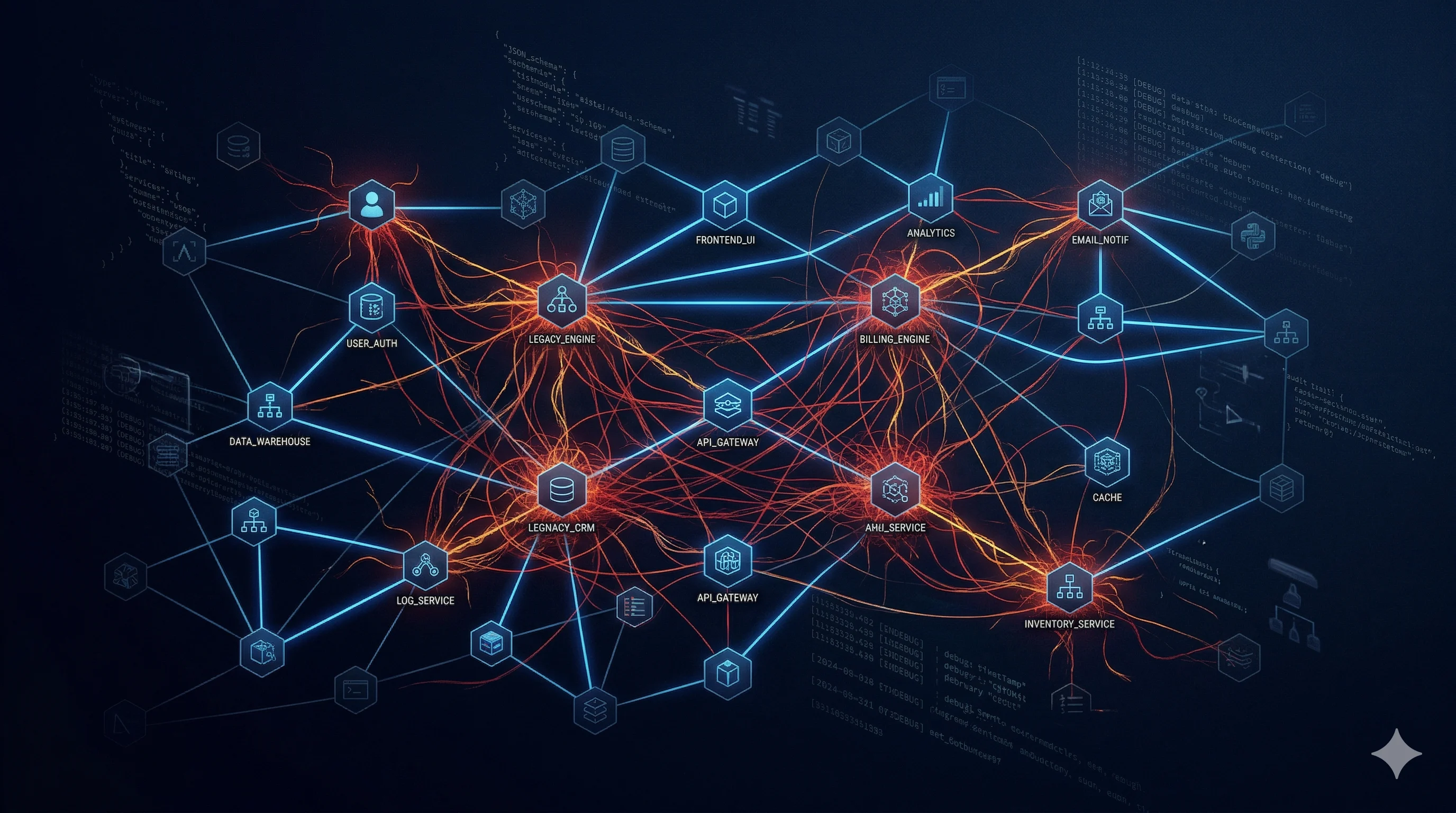
There is a paradox at the heart of modern enterprise architecture that most engineering teams discover too late: the looser the coupling between components, the more disciplined the governance of those couplings must be. Tight coupling is self-governing in a crude way. The pain of tightly coupled dependencies forces visibility and negotiation. Loose coupling, by contrast, allows dependencies to form invisibly, evolve without coordination, and break silently — until a production incident makes them suddenly and urgently visible.
Governance debt in a distributed, composable system is qualitatively different from technical debt in a monolith. It is distributed, often undocumented, and, most dangerously, invisible until it causes a failure that propagates across system boundaries in ways no single team can fully trace or resolve alone.
"Governance debt is not what you owe for the technical shortcuts you took. It is what you owe for the dependencies you formed without contracts, the events you published without schemas, and the APIs you evolved without versioning discipline."
Five Failure Modes of Ungoverned Ecosystems
These are not theoretical patterns. Each one is observed regularly in enterprise ecosystems at various stages of cloud maturity.
The Versioning Void. An API evolves. A field is renamed, a response structure changes. The producing team updates the documentation, increments the version, and moves on. But three partner integrations are still consuming the old field name. The failures surface in production days or weeks later, in systems that appear entirely unrelated to the change. Versioning discipline is a contract-management practice, not a documentation practice.
The Discoverability Desert. A new integration requirement emerges. The engineering team builds a custom data pipeline, not knowing that an internal API already exists that provides exactly this data, maintained by a different team. The duplicate capability adds maintenance overhead, introduces data consistency risk, and increases overall ecosystem fragility. An internal API marketplace or developer portal is not a compliance requirement. It is engineering productivity infrastructure.
Event Schema Drift. An event-driven architecture operates on the implicit contract that schemas are stable. As the system evolves, schemas drift. New fields are added without backwards-compatibility analysis. Consumers built against the original schema begin failing silently, processing events but producing incorrect outputs. Schema drift is particularly dangerous because the failures it produces are often not immediate. Thousands of events may be processed incorrectly before the accumulated errors become visible downstream.
The Failure Propagation Cascade. A third-party payment service degrades. The checkout service begins timing out. Retry logic amplifies the load. The inventory service, waiting for a payment-confirmed event, starts queuing jobs. Memory pressure builds. The inventory service begins failing on unrelated requests. This cascade is a familiar pattern for anyone who has operated a distributed system under production stress. The governance response is a service dependency map that explicitly models failure propagation pathways.
The Lifecycle Orphan. An API built three years ago for a specific integration. The integration was deprecated eighteen months ago. The API still exists, still receives calls from a legacy reporting process nobody updated, still appears in security scans as an attack surface, and has no named owner. Lifecycle orphans are the governance debt that compounds most silently. Automated traffic monitoring for all published APIs, combined with a formal decommissioning discipline, closes this failure mode.
The Ecosystem Governance Audit: Four Phases
This methodology is designed to be executed by a cross-functional team in two to three weeks of structured workshops, not a multi-month consulting engagement.
Phase 1: Discover. Build a complete inventory of your ecosystem's integration surface. Every API, event stream, data feed, and AI model endpoint that crosses a team or organisational boundary. This inventory rarely aligns with official architecture documentation. The gap between them is your first governance signal. Methods include automated API traffic analysis, event stream subscriber mapping, dependency scanning in deployment manifests, and structured interviews with engineering teams about integrations that are not formally documented.
Phase 2: Map. With a complete inventory, construct the dependency graph. This is the actual map of which capabilities depend on which, through what integration patterns, with what failure semantics. The failure-pathway overlay — annotating the dependency graph with the likely propagation path for each node failure — is the most operationally valuable output. It enables both proactive circuit-breaker placement and dramatically faster incident diagnosis.
Phase 3: Score. Assess governance posture across five dimensions: API versioning, discoverability, schema governance, failure modelling, and lifecycle management. This is a prioritisation tool, not a compliance exercise. The output is a governance maturity profile showing where investment will have the highest impact on ecosystem resilience and innovation velocity.
Phase 4: Act. Translate findings into a prioritised backlog of improvements, integrated into the engineering planning process alongside feature work. Governance work separated from engineering planning cycles will always be crowded out by delivery pressure. It must be visible, measured, and celebrated in the same forums where feature delivery is celebrated.
How CloudControl Helps: AppZ provides the observability and GitOps infrastructure that makes dependency discovery automated rather than manual. ManageZ gives you the 24/7 traffic visibility that surfaces lifecycle orphans and schema drift before they become incidents. DataZ brings the same discipline to data pipeline governance that AppZ brings to application infrastructure. And lowtouch.ai's Compliance Agent automates the regulatory and audit dimensions of ecosystem governance, reducing the manual effort of maintaining governance posture as systems evolve.
Governance as Culture, Not Compliance
The most technically complete governance framework fails if engineering teams experience it as overhead rather than as infrastructure that makes their work easier. The change leadership task is to design governance systems that engineers want to use because they make their lives better.
A schema registry is not a compliance artefact. It is what prevents you from debugging a mysterious data corruption issue at 2 am. An API catalogue is not a documentation requirement. It is what saves a new engineer two days of Slack messages trying to find the capability they need. A consumer registry is not overhead. It is what tells you, before you make the change, who will be affected and who needs to be notified.
"The organisations that govern their ecosystems well do not do so because they love governance. They do so because they have experienced what happens when they do not, and decided that the cost of discipline is lower than the cost of the alternative."
Start Your Audit This Week: Take one hour with your engineering leadership team and answer three questions honestly. First, can you produce a complete list of every external API your system currently consumes? Second, can you produce a complete list of every event topic your system publishes, with its current schema? Third, do you know which of your APIs have zero active consumers? If you cannot answer all three with confidence, you have already started your audit.