Most enterprises today are not suffering from a lack of monitoring. They are suffering from too much of it, and almost none of it connected in a way that actually speeds up decisions or prevents outages. Dashboards multiply. Alerts fire without context. On-call engineers spend the first 45 minutes of every incident just figuring out where to look.
That gap — between raw telemetry and actionable operational intelligence — is exactly where AIOps and modern full-stack observability come in. And in 2025, the enterprises getting this right are not just reducing MTTR. They are fundamentally changing how their platform teams operate.
The Observability Gap Is Wider Than Most Teams Admit
Traditional monitoring tools were built for a world where infrastructure was relatively static and bounded. A few servers, a handful of applications, a network perimeter you could draw on a whiteboard. That world is gone.
Today's enterprise environments run distributed microservices across multi-cloud and hybrid estates, Kubernetes clusters spanning AWS EKS, Azure AKS, Google GKE, and on-premises OpenShift, event-driven architectures generating millions of telemetry signals per minute. In that environment, monitoring a few CPU and memory metrics is not observability. It is noise with a dashboard in front of it.
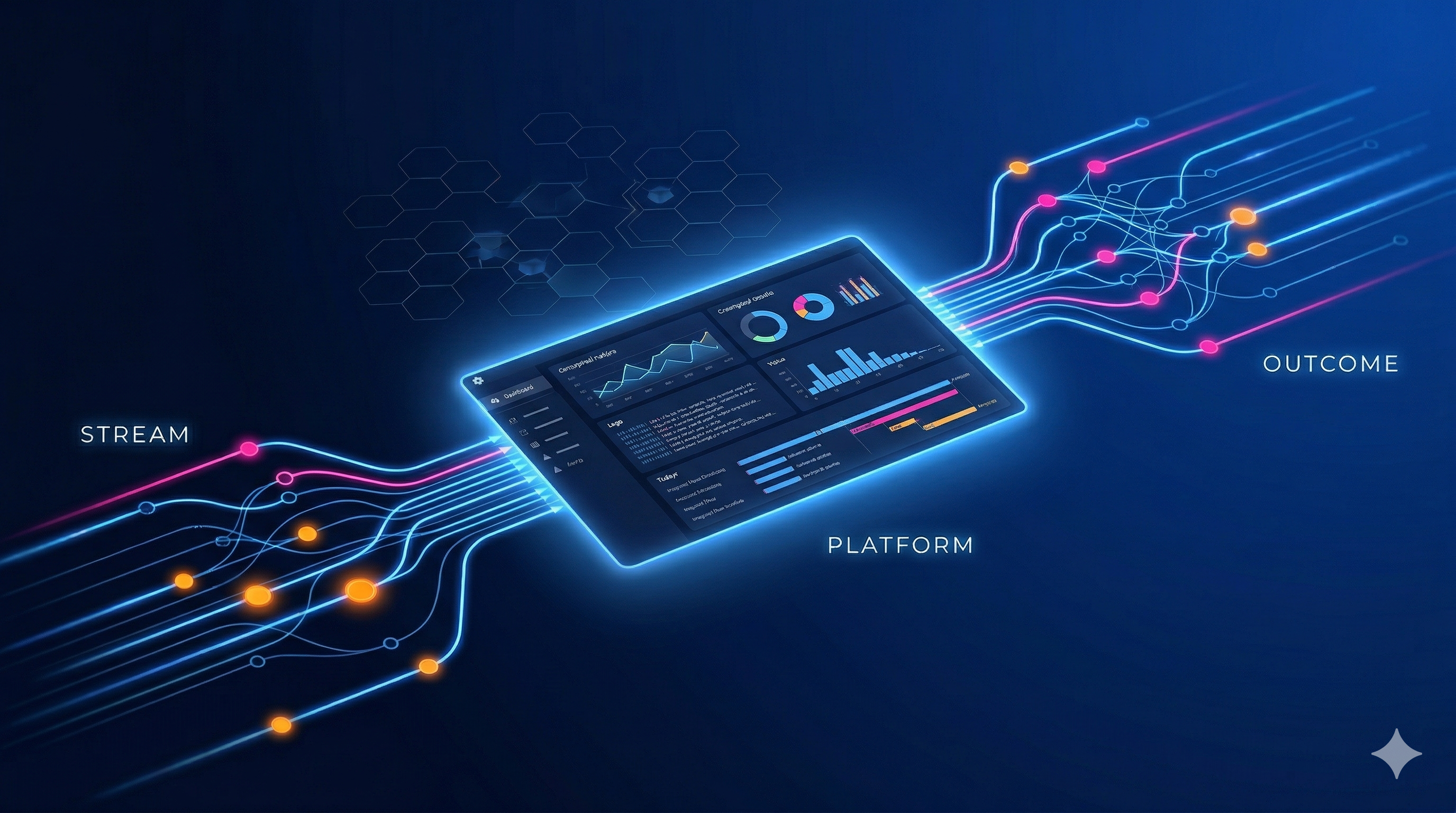
True observability in 2025 means correlating metrics, logs, distributed traces, and events into a unified operational picture — in real time, across every layer of the stack. Infrastructure. Application. Network. Database. Security. All of it, tied to the business services those layers support.
"The question is no longer whether you have visibility into your systems. It is whether your visibility is intelligent enough to tell you what matters before your customers notice it does not."
What AIOps Actually Means in a Production Environment
AIOps has been a buzzword for long enough that it has earned some skepticism. A lot of what gets sold as AIOps is really just rule-based alerting with a machine learning label slapped on it. That is not what we are talking about here.
Production-grade AIOps applies ML models to telemetry streams in real time, doing things that rules-based systems cannot. It detects anomalies before they breach defined thresholds, correlates related events across systems to surface root cause rather than symptoms, enriches runbooks dynamically so on-call engineers arrive at incidents with context instead of blank terminals, and triggers automated remediation for known failure patterns — closing the loop from detection to resolution without human intervention.
The critical governance question in regulated industries is: who is accountable when an AI model takes an automated action on production infrastructure? This is where ISO 42001, the international standard for AI Management Systems, matters. It requires that AI model decisions be explainable, auditable, and subject to defined risk controls. For enterprises in financial services, healthcare, and manufacturing, this is not optional. It is a prerequisite for deploying AI in operational workflows.
Core technologies: Prometheus · Grafana · OpenSearch / Elastic · Distributed Tracing · AIOps · Anomaly Detection · ML-Enriched Runbooks · ITIL 4 SVS · Error Budget Management · ISO 42001 · ISO 27001 · SOC 2 Type II
The Modern Observability Stack: What Best-in-Class Looks Like
The technology stack powering enterprise-grade observability has converged around a few clear components. The differences between mature operations teams and struggling ones usually come down to how well these components are integrated — not whether any single one is present.
Metrics and Real-Time Telemetry Prometheus for time-series metrics collection with Grafana for visualization. The combination provides a real-time operational dashboard across infrastructure, applications, and Kubernetes cluster health — including auto-scaling behavior, pod restarts, and resource saturation trends.
Log Analytics and SIEM Integration Centralized log management via OpenSearch or Elastic with 180-day audit-grade retention. Integrated with SIEM platforms for security event correlation, access anomaly detection, and compliance evidence collection. Log masking and RBAC ensure sensitive data is never exposed in observability pipelines.
Distributed Tracing and Service Dependency Mapping End-to-end tracing across microservices and APIs surfaces latency hotspots, cascading failures, and service dependency chains that are invisible in metric-only monitoring. Critical for diagnosing performance degradation in distributed architectures.
ISO 42001-Governed AIOps Layer ML models for predictive anomaly detection, intelligent alert correlation, and automated event orchestration. Governed under ISO 42001 for explainability and auditability. AI decisions are logged, traceable, and subject to defined risk controls for enterprise compliance requirements.
What separates an observability stack from a single-pane-of-glass operational platform is the integration layer: tying these components together into correlated, noise-reduced signals that surface what matters, and suppressing what does not. This is where most DIY observability implementations break down. The tooling is available. The integration and governance layer is where the expertise gap shows up.
Incident Management Needs to Keep Pace
Observability data is only as valuable as what your incident management process does with it. In many enterprises, the observability stack has modernized but the incident workflow has not. Engineers are still triaging alerts manually, correlating events across tools by hand, and running post-incident reviews that do not feed back into runbooks in any structured way.
ITIL 4 provides the service management framework to close this loop. The ITIL 4 Service Value System (SVS) structures incident and problem management so that detection, response, resolution, and continual improvement are connected practices — not siloed activities. When AIOps handles event correlation and initial triage, and ITIL 4 governs the lifecycle from there, the outcome is measurably faster resolution and, more importantly, fewer repeat incidents.
The SLO-driven reliability model is the other piece. Error budget management tied to defined Service Level Objectives gives engineering and product teams a shared language for reliability tradeoffs. It moves the conversation from "the site was down" to "we consumed 40% of our error budget this sprint" — which drives very different prioritization decisions.
How ManageZ Delivers This at Enterprise Scale
CloudControl's ManageZ is an ITIL 4-aligned, AIOps-powered managed SRE service built for enterprises running complex distributed workloads across multi-cloud and hybrid digital ecosystems. It is not a monitoring tool or a NOC contract. It is a fully governed SRE operating model delivered as a service.
| Commitment | Level |
|---|---|
| Uptime SLA | Up to 99.99% |
| P1 Critical Incident Response | 15 minutes |
| Cloud TCO Reduction | Up to 30% |
| NOC Coverage | 24/7 Follow-the-Sun |
The ManageZ observability architecture consolidates metrics, logs, traces, and events into a unified operational dashboard. Prometheus and Grafana handle real-time telemetry and performance visualization. OpenSearch and Elastic power centralized log analytics with 180-day retention and SIEM integration. Distributed tracing surfaces root causes across microservice boundaries. And the AIOps layer — governed under ISO 42001 — provides predictive anomaly detection, intelligent alert correlation, and automated remediation for known failure patterns.
The service runs on a follow-the-sun model with operations centers in India and Poland, providing true 24/7 coverage without the gaps that single-timezone NOC arrangements introduce. P1 critical incidents are acknowledged within 15 minutes. Structured post-incident reviews feed back into the ITIL 4 Continual Improvement Register (CIR), so the same incidents stop recurring.
Kubernetes-First Platform Operations
ManageZ is built around Kubernetes-first platform operations, with management across EKS, AKS, GKE, LKE, OpenShift, and Rancher. This includes auto-scaling, self-healing cluster configurations, blue/green deployments, and multi-cluster governance — all integrated into the observability and incident management framework. Automated patch management covers OS, container, and Kubernetes cluster layers with pre-patching compliance validation and drift prevention, eliminating one of the most persistent sources of operational toil for platform teams.
FinOps and Cloud Cost Governance
Observability does not stop at application and infrastructure layers. ManageZ integrates FinOps-driven cloud cost governance, with continuous spend analysis, anomaly detection on cost patterns, and automated rightsizing recommendations across multi-cloud estates. This is operationally significant: cloud cost overruns are often a symptom of the same configuration drift and capacity management gaps that create reliability risk.
Compliance Is Built In, Not Bolted On
For enterprises in regulated industries, the compliance posture of the SRE operating model is not a secondary concern. It is often the deciding factor in whether a managed service engagement is viable at all.
ManageZ is built on a layered compliance architecture:
- ITIL 4 — Service management framework governing incident, problem, and continual improvement workflows
- ISO 42001 — AI governance: every automated AIOps decision is explainable, logged, and risk-controlled
- ISO 27001 — Information security: AES-256 at rest, TLS 1.2+ in transit, RBAC, breakglass access governance, continuous audit evidence
- SOC 2 Type II — Automated log collection, policy enforcement, and monthly reporting
- PCI DSS — Network segmentation, hardened container images, continuous vulnerability scanning
- GDPR / HIPAA / RBI — Data residency controls, log masking, and configurable retention policies
ISO 42001 governs the AIOps layer specifically. Every automated decision made by ML models in production is explainable, logged, and subject to defined risk controls. For a CISO or compliance officer, this answers the accountability question that blocks most AI-in-operations deployments.
From the Field: A Financial Technology Migration
A mid-market fintech company was carrying hyperscaler cost overruns, technical debt across IaC and configuration management, and no structured incident management process. CloudControl executed a full cloud migration in eight weeks, modernizing the platform with Infrastructure-as-Code, GitOps-driven change enablement, and a Prometheus/Grafana/Elastic observability stack.
ManageZ SRE then took over 24/7 AIOps-driven operations, introducing ITIL 4-aligned incident and problem management, automated patch management, ISO 27001-aligned access governance, and continuous FinOps optimization. The customer achieved sustained 99.99% uptime, eliminated infrastructure toil, gained full audit trail coverage, and established an audit-ready posture for SOC 2 and PCI DSS within the first operating quarter — with zero application code changes required.
| Outcome | Result |
|---|---|
| Uptime Achieved | 99.99% |
| Migration to SRE Go-Live | 8 weeks |
| Cloud Cost Reduction | 30%+ |
| Application Code Changes | Zero |
| Audit Trail Coverage | 100% |
What This Means for Platform and Engineering Leaders
If your platform team is spending meaningful engineering time on alert triage, manual patch coordination, or building internal observability tooling, that is a resourcing decision that deserves scrutiny. The technology and the operating model to handle all of that — governed and compliant — exist as a service today.
The more important conversation is about what your engineering team should be doing instead. Product features. Architecture improvements. Technical debt that actually blocks business outcomes. Every hour spent on infrastructure toil is an hour not spent there.
AIOps and modern observability are not about replacing SRE engineers. They are about giving them a platform that does the low-signal work automatically, so their attention stays on the high-value problems that actually require human judgment. That is the operational model ManageZ is built to deliver.
Ready to modernize your platform reliability operations? Let's talk about what a governed, ITIL 4-aligned ManageZ SRE engagement looks like for your environment, your compliance requirements, and your team. Reach out at mrsiddiqui@ecloudcontrol.com.