This is Article 01 of 03 in the Beyond the Container series — three articles for engineering leaders navigating the post-Kubernetes era.
Kubernetes gave us something genuinely valuable: a common language for infrastructure. Container images became portable, reproducible units of deployment. Teams aligned around YAML, registries, and control loops. For stateless, CPU-bound workloads running in a well-connected data center, that model delivered real results.
But the container model was designed for a world that has moved on. The assumptions baked into it — homogeneous networks, fungible hardware, processes as the unit of deployment, acceptable orchestration overhead — are colliding with where modern enterprise workloads actually live and run.
At CloudControl, we help enterprises migrate, modernize, and manage their cloud infrastructure every day. And we see these collisions up close. This article is about what the limits of the container model look like in production, and where the smarter primitives are coming from.
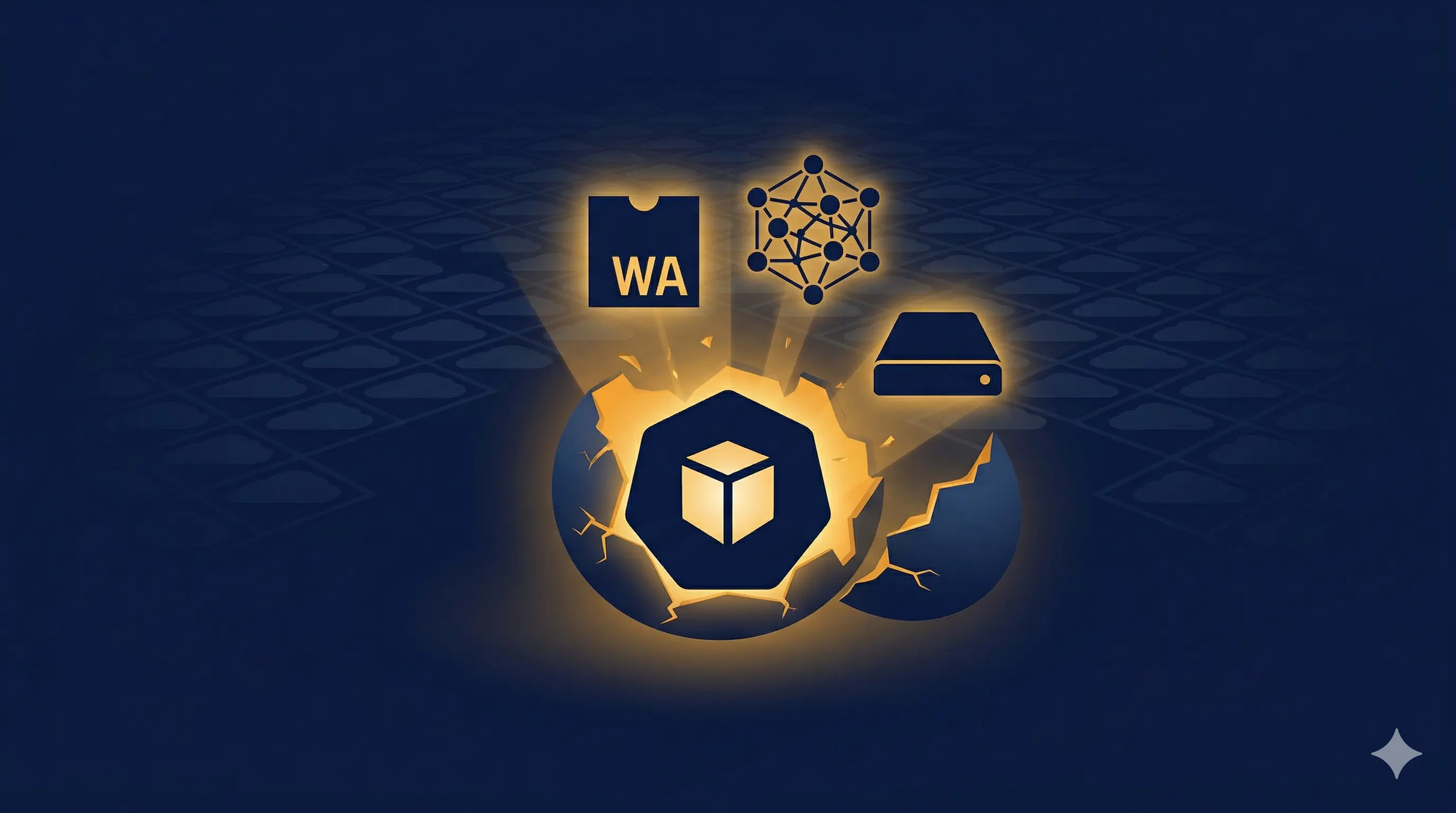
Four Places Where the Container Model Breaks Down
1. The Edge
Kubernetes assumes low-latency, high-bandwidth connectivity between nodes. At the edge, that assumption dissolves. A 50ms round-trip to a Kubernetes control plane is already 50ms too slow for real-time inference at a factory floor or retail edge node. Lightweight runtimes like KubeEdge and OpenYurt are useful workarounds, but they are still working around the model's constraints rather than solving them.
2. Serverless Cold Starts
Container image sizing is designed around processes, not ephemeral function invocations. The cold-start problem — 250ms to 2 seconds for JVM-based functions — is not a tuning issue. It is a category mismatch. WebAssembly runtimes that initialize in microseconds make this visible: a Spin-based WASM component cold-starting in 1ms versus a containerized Node.js function at 400ms is not a marginal improvement. It is a different class of compute primitive.
3. Accelerated Hardware
Kubernetes schedules at the node level and treats hardware as interchangeable. Data Processing Units, CXL-attached memory pools, high-bandwidth GPU interconnects — these have no vocabulary in the standard Kubernetes scheduler. Enterprises building production AI workloads are already wrestling with this: custom device plugins, extended resource types, and GPU-aware scheduling extensions that feel like pushing against the grain rather than working with it.
4. Quantum-Adjacent Workloads
Quantum and quantum-inspired workloads operate on fundamentally different computational primitives. A qubit is not a thread. A quantum circuit is not a container workload. This is not yet an acute operational problem for most enterprises, but the window for building toward hybrid classical-quantum infrastructure is now. Organizations that start thinking about new primitive stacks today will be positioned when the 2027–2030 timeframe arrives.
"The most dangerous infrastructure decisions are not the ones that fail immediately. They are the ones that succeed for five years and then become the thing that prevents you from doing the next necessary thing."
From Declaring Resources to Declaring Outcomes
Kubernetes is, at its core, an imperative system. You declare desired state, but the system's internal logic is procedural: scheduler, kubelet, controller loops, admission webhooks. True intent-based infrastructure goes a level above. You declare an outcome, not a topology.
The difference is concrete. In a Kubernetes-native model, you specify: "run three replicas of this container on nodes with at least 4 CPU cores in eu-west-1." In an intent-based model, you declare: "serve this inference endpoint at 10ms P99, within a defined cost envelope, with EU data residency." The infrastructure resolves that intent and reassembles as conditions change.
| Model | Deployment Behavior | Key Advantage |
|---|---|---|
| Kubernetes | Pod scheduled to Node; network configured around it | Widely supported; strong ecosystem |
| WebAssembly (WASM) | Component instantiated in microseconds at the event point | Hardware-agnostic, microsecond cold start |
| Event Mesh | Workload routed to compute based on event context | Location-transparent, topology-independent |
| CrossPlane | Infrastructure resources managed via unified API across providers | Provider-agnostic control plane |
The Emerging Primitives Worth Watching
WebAssembly Components provide a composable, language-agnostic deployment unit that initializes in microseconds. Platforms like wasmCloud and Fermyon Spin are building production-grade application platforms on WASM. The key insight is that WASM is not a universal container replacement; it is the right primitive for event-driven, edge-deployed, security-critical function workloads where container process overhead is a structural liability.
Event Mesh Architectures using NATS, Solace, or Confluent enable a different infrastructure topology entirely: workloads that travel to data rather than data traveling to fixed workloads. Computation routes to wherever it can be executed appropriately — by latency, cost, carbon intensity, or data sovereignty constraints.
CrossPlane has emerged as the most credible infrastructure-as-code evolution beyond Terraform for multi-cloud environments. It lets organizations define higher-level infrastructure abstractions ("a production-grade database") rather than resource-specific configurations, and lets the control plane resolve those abstractions to the right provider.
What This Means for Your Architecture Roadmap
At CloudControl, our AppZ platform and ManageZ managed services are designed around a Kubernetes-first approach, but we build with these limitations in mind. Our customers are not running yesterday's workloads. They are migrating legacy systems, building new cloud-native applications, and increasingly running AI inference workloads that push against the container model's boundaries.
The practical steps are straightforward. Audit your most latency-sensitive and cost-sensitive workloads against the container model's four assumptions. Run a WebAssembly spike on one internal service and measure cold-start delta and portability. Evaluate CrossPlane as your multi-cloud control plane if you are spanning two or more providers. And start developing an intent vocabulary for your infrastructure — defined by business outcomes, not technical specifications.
Practical challenge for your next architecture review: Map three production workloads against the container model's core assumptions — network homogeneity, hardware fungibility, process as the deployment unit, and acceptable orchestration overhead. How many assumptions hold? Where are the silent constraints on what you could otherwise achieve?
CloudControl helps enterprises move faster on cloud, without the sprawl. Our AppZ migration and platform engineering platform supports 140+ technology stacks and gets applications into Kubernetes-based production environments in days, not months. Explore AppZ at ecloudcontrol.com
Next in the series: Your Dashboards Are Lying to You — why pod-level metrics are the rearview mirror of a system already in distress.