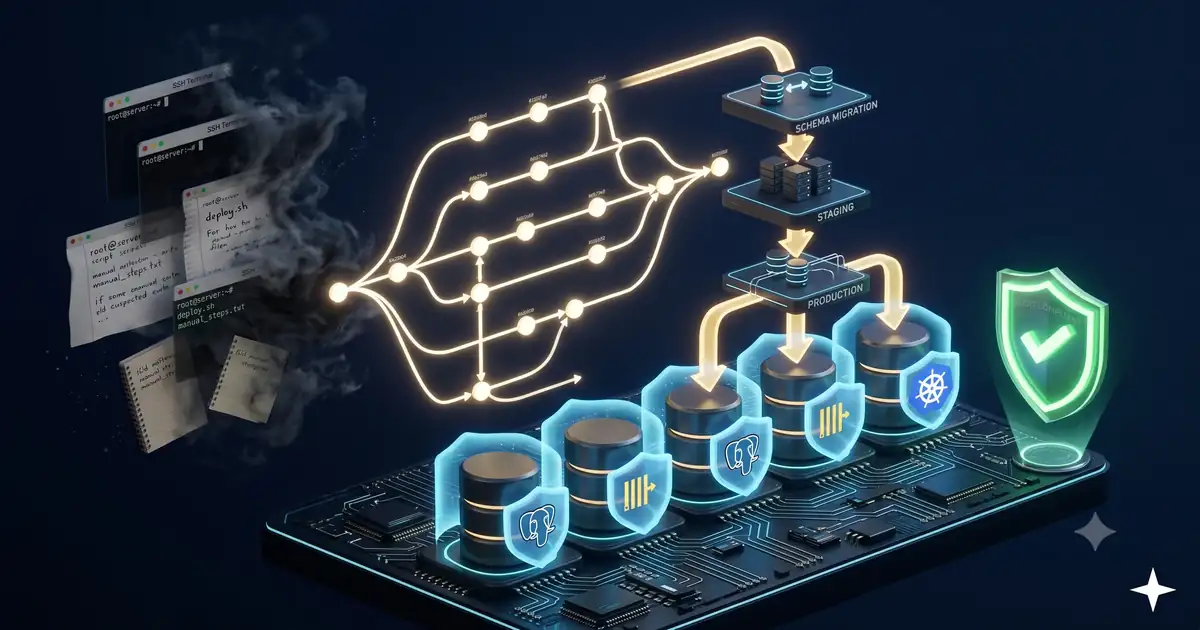
Every SRE team we have worked with has a version of the same confession: application deployments are clean, automated, and fully reproducible. Databases? A different story entirely. Manual scripts, tribal knowledge, and enough audit risk to make a compliance officer lose sleep.
GitOps changed how the industry thinks about infrastructure. But for most organizations, databases got left behind. That gap is where eCloudControl focuses.
The Real Problem with Traditional Database Management
Traditional database management has three compounding problems that most teams quietly accept as the cost of doing business.
It is manual. DBA runbooks, ad hoc migration scripts, and SSH sessions into production are not just inefficient. They are invisible to the rest of the platform. No version history. No peer review. No automated rollback.
It is opaque. When something breaks, the question "what changed and when?" is surprisingly hard to answer. Schema changes applied directly to production leave no trail that integrates with your incident management or change control systems.
It is audit-unfriendly. Regulated industries in banking, insurance, and healthcare need to demonstrate exactly what configuration was applied, by whom, and when. A manual, imperative approach to database operations makes that almost impossible without a parallel documentation burden that nobody maintains reliably.
This is the operational debt that most teams carry silently, until a production incident or a compliance review forces the conversation.
What GitOps Actually Means for Databases
GitOps is a methodology where Git serves as the single source of truth for your system's desired state. Automation continuously reconciles the live environment to match what is declared in the repository. Changes happen through pull requests. Rollbacks are a git revert. Drift is detected and flagged automatically.
For application workloads, this is now mainstream. For databases, the concept is the same but the implementation is more nuanced.
Applying GitOps to database schema management means your schema definitions, migration scripts, and configuration are version-controlled YAML or declarative manifests. A developer proposes a schema change through a PR. It gets reviewed, approved, and merged. The pipeline applies it consistently across dev, staging, and production with full audit trails.
For database infrastructure itself — including provisioning, scaling, backup policies, and replication topology — GitOps means using Kubernetes Operators with Custom Resource Definitions (CRDs) that expose database configuration as simple YAML files. You declare the desired state of your PostgreSQL cluster, your Redis instance, or your columnar store. The operator reconciles the live cluster to match. No imperative commands. No manual steps that only one person knows how to run.
How Container Orchestration Enables the Full Database Lifecycle
Kubernetes has matured significantly in its support for stateful workloads. StatefulSets provide stable network identity and persistent volume management. Persistent Volume Claims decouple storage from pod lifecycle. Kubernetes Operators encode Day 2 database operations — including high availability, backups, failover, and schema migration — into automation that runs as part of your cluster.
The practical result: the full database lifecycle becomes manageable through the same GitOps toolchain your team already uses for applications.
- Provisioning a new database instance is a YAML manifest committed to Git
- Schema migrations run as CI/CD pipeline steps, validated before reaching production
- Scaling is a configuration change, reviewed and merged like any other code change
- Backup and recovery policies are declared, not scripted
- Decommissioning is tracked and reversible
This is not theoretical. Teams running PostgreSQL, MySQL, ClickHouse, and columnar engines like Apache Cassandra on Kubernetes are already managing the full database lifecycle this way, using tools like the Crunchy Data PostgreSQL Operator, Strimzi for Kafka, and ArgoCD or Flux CD as the GitOps engine.
Real-World Use Cases: Relational and Columnar Engines
Relational databases (PostgreSQL, MySQL). GitOps-managed PostgreSQL deployments allow teams to version-control not just schemas but replication topology, connection pooling configuration, and backup schedules. Schema migrations that previously required a change control ticket and a DBA on call become standard pull request workflows, with automated testing in the pipeline before promotion to production.
Columnar and analytical databases (ClickHouse, Redshift-compatible). Columnar engines used for analytics workloads benefit significantly from declarative configuration management. Partition schemes, retention policies, and materialized view definitions are code: diffable, reviewable, and rollback-safe.
Multi-environment consistency. One of the most underappreciated wins from database GitOps is environment parity. The same manifests that define your production database cluster define your staging and development environments, scaled down. "It works in staging" stops being a hollow phrase.
Why Regulated Industries and Open-Source Teams Prefer This Model
For regulated industries, the value proposition is compliance by default. Every schema change, every configuration update, and every infrastructure modification exists as a git commit with an author, a timestamp, a reviewer, and a merge approval. That trail satisfies audit requirements without parallel documentation effort. For organizations operating under RBI, GDPR, SOC 2, or similar frameworks, this is not a convenience. It is a control.
For open-source-first engineering teams, the appeal is different: avoiding managed cloud database lock-in while retaining operational sophistication. Running PostgreSQL or ClickHouse on Kubernetes with GitOps-managed lifecycle gives teams full control over versions, configurations, and data residency, without handing operational responsibility to a cloud provider's managed service layer. For organizations with data sovereignty requirements or cost optimization mandates, this matters considerably.
Both audiences share a common motivation: they want database operations to be as reproducible, transparent, and auditable as the rest of their platform.
What This Looks Like in Practice at eCloudControl
The teams we work with do not adopt database GitOps all at once. The pattern that works is incremental.
First, schema migrations move into the CI/CD pipeline. Liquibase or Flyway, running as pipeline steps, with migrations reviewed in PRs alongside application code. This alone eliminates a significant category of production incidents.
Second, database infrastructure — including provisioning, backup policies, and connection configuration — migrates to declarative manifests managed through ArgoCD or Flux. Operators handle the reconciliation. The team stops logging into production database hosts for routine changes.
Third, observability and incident response are connected to the same Git history. When an alert fires, the first question is "what changed?" and the answer is a git log away, not a conversation with whoever was on call.
The result is not just operational efficiency. It is a database environment that a compliance team can audit, a new engineer can understand without six months of context, and an SRE team can recover from incidents without archaeology.
The Shift Worth Making
Databases do not have to be the part of your platform that lives outside the reproducibility guarantees you apply everywhere else. The tooling exists. The patterns are proven. The barrier is organizational, not technical.
If your team is managing application infrastructure through GitOps but still handling database changes through runbooks and direct access, the gap between those two approaches is where your next major incident is waiting.
eCloudControl's AppZ platform and SRE agents help enterprise teams close that gap, connecting GitOps-managed database operations to centralized observability, automated remediation, and compliance-ready audit trails. Book a discovery call with our solutions team to see how this works in your environment.